


Biohacking Your Circadian Rhythm
We’ve all heard the saying that we need 8 hours of sleep for proper rest and recovery. But how did we come to know that this is the ideal amount of time? It all comes down to circadian rhythms and how they affect the quality of our sleep and our overall well-being. According to data from the National Institutes of Health, the central circadian clock is located in the suprachiasmatic nucleus of the brain. It is this nucleus that synchronises all our biological processes with the light and dark periods of the day.
Today we will learn more about them, understand how to reset the circadian rhythm, and discover which tools can help us do so. Our experts have reviewed the latest research on circadian rhythms. Taking chronobiology into account, they have drawn on data from the National Institutes of Health and Harvard Medical School. In this article, we will discover what will help you regulate your internal clock, and what you should avoid.
Highlights
- Circadian rhythms are the body’s internal 24 hour biological clock that regulates sleep wake cycles, metabolism and energy.
- Biohacking circadian rhythms means aligning daily habits with the body’s natural internal clock.
- Light exposure, meal timing, and sleep schedules are the basics of regulating your internal clock.

Contents
What Is Circadian Rhythm?
Put simply, circadian rhythms are our internal biological clocks, which automatically adjust to day and night. This mechanism is fundamental to the entire body, and it is important to maintain its balance. In 2017, Jeffrey C. Hall, Michael Rosbash and Michael W. Young were awarded the Nobel Prize in Physiology or Medicine for their discovery of the molecular mechanisms controlling the circadian rhythm. They identified the gene that controls the biological clock. The scientists demonstrated that it encodes a protein which accumulates in the cell during the night and is then broken down during the day.
Shortly afterwards, they explained the workings of the entire mechanism that governs circadian rhythms within the cell. In humans, the biological clock is controlled by the hypothalamus, specifically the suprachiasmatic nucleus. It receives information from the senses and receptors and adjusts our internal timers. This nucleus regulates the production of the hormones melatonin and cortisol. Thanks to this, we maintain our activity or, conversely, recover our strength.
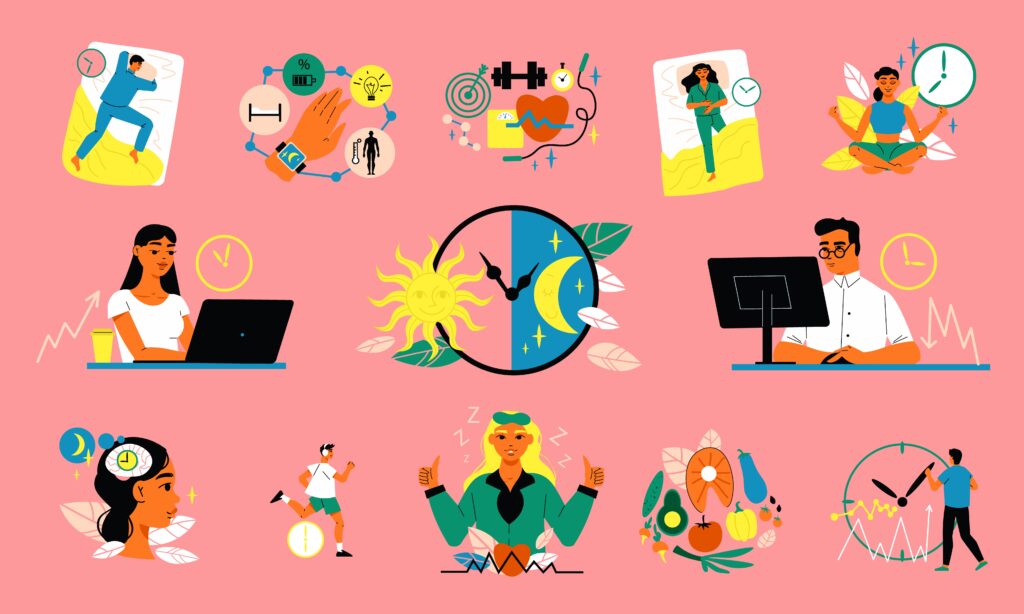
How the Body’s Internal Clock Works
Now let’s try to understand exactly how your internal clock works. Despite modernisation and industrialisation, humans remain subject to natural phenomena, just like our ancestors. Essentially, it’s the same 24-hour cycle that makes up our day. It is synchronised with hormone activity and light. For example, during the day, the production of melatonin – the sleep hormone – is blocked. This is why we feel a surge of energy. But when night falls, its production is activated. The suprachiasmatic nucleus in the brain receives the necessary signals and unconsciously adjusts the functioning of the entire body. A person with a well-tuned circadian rhythm could sometimes even wake up before the alarm clock. It happens because their body knows when it’s time to get out of bed.
Why Circadian Rhythm Is Important for Health
Circadian rhythms are important precisely because they regulate hormones and distinguish between night and day. For a healthy body, they must be in balance. The functioning of all internal organs depends on this synchronisation. Your immune system also depends on circadian rhythms. They regulate the functioning of the cardiovascular system. This reduces the risk of chronic diseases and inflammation.
Furthermore, circadian rhythms influence our metabolism and weight. Quite often, people notice weight loss after improving their sleep. As shown in the Circadian Disruption and Cardiometabolic Disease Risk (Obesity, 2023), disruption of the circadian rhythm is associated with an increased risk of obesity, diabetes and cardiovascular disease.


Signs Your Circadian Rhythm Is Off
As you can see, if this system is disrupted, the body’s entire rhythm is thrown off balance. Let’s look at the main signs that it’s time to pay attention to your circadian rhythms:
- You feel sleepy throughout the day;
- You have more energy at night;
- You have trouble concentrating;
- You often wake up during the night and have trouble falling asleep;
- You suffer from insomnia;
- Increased appetite at night.
How to Reset Your Circadian Rhythm Naturally
If you notice any of the symptoms described above, it’s not the end of the world. Like many things in our bodies, circadian rhythms can be adjusted through specific actions. Of course, discipline and determination are key, so you should incorporate the following points into your daily routine and stick to them.

Correct Your Sleep Schedule
A fixed sleep schedule stabilises your circadian rhythm through repetitive cues. A 2017 study published in Scientific Reports showed that irregular sleep is strongly linked to a decline in metabolism. Even if you get enough hours of sleep, a chaotic sleep pattern takes its toll. You can train your brain to anticipate when it is time to sleep and wake up. This normalises melatonin production.
Proper Lighting
This point is very important, as light acts as a signal for circadian rhythms. Let’s discuss what you should do both in the morning and at night.
- Daylight. Morning light triggers the biological day by suppressing melatonin. It also raises cortisol levels at the right time. This helps the body wake up. That is why it is important to get light immediately after waking up.
- Evening Light. Blue light in the evening suppresses melatonin and delays sleep. This disrupts the natural cycle. It is therefore best to minimise screen time before bed and use special glasses that block blue light. For example, Sol Nighttime Blue Light Blockers can be useful for this.

Digital Hygiene
To establish a healthy routine, it is important to pay attention to how much time you spend in front of screens. They stimulate the brain and delay the process of falling asleep. Furthermore, they create additional cognitive strain. Scrolling through social media feeds also stimulates the release of dopamine, which makes it harder to fall asleep. It is therefore important to reduce screen time before bed and put away your gadgets a few hours before sleep. Screens stimulate the brain and delay the onset of sleep. If you need something to occupy yourself with, try reading a book the old-fashioned way. This helps to reduce anxiety and improve the quality of your sleep.
Meal Timing
The time at which you eat can also affect your internal clock. The Meal Timing Circadian Study shows that this disrupts circadian rhythms. Late dinners shift metabolic rhythms. Which in turn affects both metabolism and sleep.
Exercise Timing
Physical activity, on the other hand, can help regulate brain chemistry. This is due to body temperature and the hormones released during exercise. For example, morning exercise gets the body going, so it’s a good idea to do strength training and high-intensity cardio at this time. In the evening, it’s better to set aside time for something more calming. For example, yoga nidra will calm your mind and prepare you for sleep. If you prefer intense evening workouts, try to do them 3-4 hours before going to bed.
Use Caffeine Wisely
Generally speaking, caffeine isn’t something to be avoided. However, it affects circadian rhythms because of adenosine. This is a nucleoside found in our cells that influences energy metabolism. By consuming caffeine in the evening, you mask your tiredness and delay sleep. A 2015 study published in Science Translational Medicine shows that caffeine shifts the circadian phase. It is therefore best to avoid a cup of coffee before bed.

Relaxation Techniques Before Bed
You can also use certain techniques to lower your cortisol levels and prepare your body for sleep. All it takes is half an hour before you go to bed. Meditation and breathing exercises help to relax your muscles, improve your focus on your inner sensations, and trigger the processes that lead to a good night’s sleep.
Sleep Tracking Apps and Devices
If you find it difficult to track your results on your own, try specialised tracking devices. They provide objective data and allow you to assess your progress. These can include tracking wristbands or even smart beds. Take the Pod 4 Ultra, for example. It is a mattress that tracks your sleep phases and body temperature. With its help, you can improve your rest and get a better quality of sleep. You begin to adjust your behaviour without even realising it.
Improve Your Sleep Environment
The room you sleep in is just as important. Remember that a quiet environment is particularly important, as this allows your body to relax completely. The temperature of your room also affects the quality of your sleep. Ideally, the room should be slightly cool. When the room is kept at a temperature of 16-19°C and is dark, this stimulates the production of melatonin.
Supplements for the Circadian Rhythm
If none of the above measures has helped, you might also consider dietary supplements to regulate your body clock. For example, melatonin can help improve sleep. It signals to the body that it is time to go to bed. It is also an effective remedy for jet lag. However, do not take melatonin long-term, as it can be habit-forming and your body may stop producing it naturally. It is also important to be in a dark room when taking melatonin, as it only works in such conditions. Recently, the ingredient cannabinol (CBN) has been gaining popularity. This substance is derived from medical cannabis. It has a sedative effect and improves sleep. For example, Sleep Blend contains various relaxing oils, including CBN.
Please remember that it is important to consult a specialist before taking any medication! Consult your doctor before starting a course of treatment and make sure it is safe for you to do so.
Circadian Rhythm for Shift Workers
The problem with shift work lies in the conflict between the work schedule and our body’s biological clock. This can be difficult for our bodies to adapt to, which is why chronic sleep disorders may occur. As a result, such workers may experience a weakened immune system and an overall decline in quality of life.
The most effective strategy for this type of work schedule is the artificial control of light and darkness. During night shifts, try to use the brightest light possible. This creates a ‘daytime’ effect at night. It shifts the circadian rhythm and suppresses melatonin production. At home, however, block out sunlight and create the strongest possible sense of night.
It is also important to structure your sleep. Sleep for one main block of 4-6 hours and add a short nap during the day if necessary. It is important to stick to a fixed sleep schedule even at weekends, otherwise the body will not have time to adapt. Additionally, low-dose melatonin can be used to help you fall asleep more quickly, but only as a temporary measure.

How Long Does It Take to Reset Your Circadian Rhythm?
That point is quite individual. Also, it’s important how exactly your circadian rhythm has been disrupted. Sometimes you get better after a few days of a proper schedule. But if there are issues such as jet lag or insomnia, recovery may take even weeks. Mostly it takes between 3 and 10 days to reset your body and get it back on track.
If you have jet lag, you can use this as a guide: about one day per time zone, roughly 1-1.5 hours per day. If you work shifts or have experienced a prolonged disruption to your routine, the process may take several weeks. The quickest way to speed up adaptation is to control morning light. And strictly stick to a fixed wake-up time.
Triggers of Circadian Rhythm Disruption
Let’s look at the most common causes of disruption to our internal clock. These are usually the factors that affect our circadian rhythms. We can eliminate some of them through self-discipline, but there are others that are difficult to avoid, such as changing time zones. However, knowing what they are will make it easier for you to restore your body’s balance. Common causes of circadian rhythm disruption:
- jet lag;
- shift work;
- irregular sleep;
- stress;
- use of gadgets;
- alcohol;
- night-time light;
- lack of daylight;
- exercising less than 4 hours before bed.

Summary
Now we know a little more about how our bodies work. We’ve explored what circadian rhythms are and how they affect our health. They determine how quickly you lose weight, your mood, and your energy levels. If your circadian rhythms are disrupted, your concentration will drop and you’ll often suffer from insomnia. This interferes with daily life. But they can be regulated. Here are a few tips on how to improve them and balance your body’s functions:
- Get some morning light
- Establish a sleep routine
- Avoid light in the evening
- Monitor your food and caffeine intake
- Create the right environment
- Use a tracking app
- Don’t rely solely on supplements
for subscribing!