


Women and Longevity: Why Female biohacking requires a different approach
Women’s longevity isn’t just decided by genes and hormones, but also by everyday habits that match what her body needs. We’ll look at why biohacking works differently for women, covering everything from food and workouts to rest and stress, and how matching your daily habits to your hormone cycle can boost energy, protect your health, and help you live longer and healthier.
Highlights
- Women’s longevity depends on daily habits, not just genetics.
- Strength training, protein intake, sleep, and stress control are key.
- Menopause and hormonal cycles require tailored biohacking approaches.
- Preventive care and social connection support long-term healthspan.

Contents
Many popular biohacking tips revolve around the idea of consistent performance: eat less, exercise more, and demonstrate endurance. But a woman’s body operates in cycles, and her hormonal balance changes throughout the month. Because of this, nutrition, exercise, and recovery can affect well-being differently across the cycle’s phases. Many biohacking tips work, but not all are suitable for women. Instead of providing the expected benefits, some habits can actually increase fatigue, disrupt the menstrual cycle, and affect hormonal balance. How can women adapt the basic rules of biohacking?
Why do women live longer than men
Globally, women outlive men by an average of 4 to 5 years. This gap in longevity is influenced by a combination of genetics, hormones, immune function, and behavioral risk factors.
Global lifespan trends
According to mortality data from the Our World in Data project, the female survival advantage is remarkably consistent. In nearly every country worldwide, women live longer than men on average. This gap narrows in regions affected by certain socio-economic disadvantages, but it persists across diverse cultures and historical records.
Genetic advantages
- The second X chromosome: Women have two X chromosomes, while men have an X and a Y. This redundancy acts as a built-in genetic buffer. If a gene mutation or defect occurs on one X chromosome, the second healthy X chromosome can often compensate for it. Men, having only one X chromosome, lack this backup mechanism.
Hormonal influences
- Estrogen protection: Endogenous estrogen, the dominant female sex hormone during reproductive years, is highly protective of the cardiovascular system. Estrogen helps maintain flexible blood vessels, regulates healthy cholesterol levels, and minimizes inflammation, which significantly lowers the risk of heart disease until menopause.
Cardiovascular differences
- Delayed heart disease: Because of the biological changes and cardioprotective effects tied to estrogen and hormonal cycles, women generally develop cardiovascular disease 7 to 10 years later in life than men. Men face a higher risk of early mortality from cardiovascular events at an earlier age.
Immune system differences
- Stronger responses: Research indicates that females typically possess stronger innate and adaptive immune responses. Their bodies mount more efficient responses to infections. However, this heightened immune activity also predisposes women to a higher prevalence of autoimmune disorders.


Lifespan vs. healthspan
Lifespan and healthspan measure two very different aspects of longevity, as outlined by Harvard Health:
Lifespan is simply the total number of years you live, from birth to death.
Healthspan is the number of those years lived in good health, free from chronic diseases and disabling conditions.
While women have longer lifespans, they also, on average, spend more total years in poor health or managing chronic age-related conditions compared to men.
Understanding female hormones and aging
While men’s hormonal systems operate on a 24-hour cycle, women’s 28-day cycle plays a key role in determining their hormonal profile. During its four phases, varying amounts of estrogen, progesterone, FSH, LH, and testosterone are produced. These varying concentrations can lead to both a surge of energy and self-confidence, especially in the first half of the cycle, and a need for rest in the second half. These same hormones can ultimately have negative effects as well, ranging from heavy menstrual bleeding to polycystic ovary syndrome (PCOS) and endometriosis. A significant number of women also suffer from depression, autoimmune diseases, and migraines. Many women have difficulty conceiving.
For women to effectively use biohacking, they should familiarize themselves with their hormonal profile and always know which phase of their cycle they are in at any given moment. Only then can you fully harness the potential of biohacking. For example, in the first half of the cycle, estrogen levels rise sharply, while the body processes metabolic byproducts more slowly. In the second half of the cycle, however, progesterone production increases, which requires a great deal of energy, especially during menstruation. A properly tailored diet and the necessary micronutrients will provide your body with optimal support.
Female biohacking: what should be different?
There are some crucial points in biohacking that women must change for themselves to achieve the best results and not damage themselves.
Don’t fast for too long
Intermittent fasting has become one of the most popular biohacking practices. However, eating patterns that work well for men aren’t always safe for women. If prolonged periods without food become regular, the body may interpret them as a signal of resource scarcity.
In response to this stress, the endocrine system’s functioning changes. During a prolonged energy deficit, the body begins to conserve energy, which in some women can affect estrogen levels, menstrual cycle regularity, libido, and overall well-being. This period becomes particularly sensitive during the second half of the cycle, when the body already requires more energy.
This is precisely why many experts recommend that women follow gentler intermittent fasting regimens, for example, with a break of about 12-14 hours between dinner and breakfast, rather than 16-18 hours. It’s also important to focus not on one-size-fits-all rules, but on how you feel and to take your menstrual cycle phase into account. If prolonged fasting leads to constant fatigue, irritability, or menstrual irregularities, you should reconsider this regimen.
Don’t exercise on an empty stomach
A light snack before a workout helps reduce unnecessary stress on the body. Many people start their day with a run or a strength-training session before they’ve had time to eat breakfast. However, for a woman’s body, this habit can become an additional strain. Cortisol levels are already naturally elevated in the morning, so intense exercise on an empty stomach can amplify this effect.
When cortisol levels remain consistently high, the body has a harder time coping with stress, which over time can affect hormone balance, energy levels, and even the menstrual cycle. That’s why experts recommend having a light snack before your workout, for example, a banana, plain yogurt, or toast with peanut butter. This small meal won’t interfere with your workout and will help your body handle the physical strain more easily.
By the way, when it comes to nutrition, depending on the phase of their cycle, women who practice biohacking should choose foods that support them at each stage. For example, during the follicular phase, it’s important to consume foods that promote the elimination of metabolic waste, such as fresh vegetables, legumes, or fermented foods.
During ovulation, when body temperature rises, fresh salads and smoothies will help you feel refreshed, while fiber-rich foods will provide support during this energetic period. During the luteal phase, it’s important to satisfy food cravings with the most filling foods possible, such as berries, nuts, whole grains, or legumes. During menstruation, your diet should include foods that stimulate blood production and promote hormonal balance. These include lentils, tofu, meat, and leafy green vegetables.

Don’t forget about recovery
Daily intense workouts with no days off are considered the fastest way to lose weight. In reality, the body needs time to recover after exercise. If you consistently neglect rest, it can lead not only to a decline in athletic performance but also to health issues.
It’s especially important to take into account the unique characteristics of the female body. During the first half of the menstrual cycle, many women do indeed find it easier to handle strength training and high-intensity workouts. In the second half, energy levels drop, so experts recommend reducing workout intensity and incorporating walks, stretching, yoga, or pilates. This approach helps avoid overtraining and unnecessary stress on the endocrine system.

Don’t overdo cold treatments
Ice baths, cold showers, and cryotherapy have become a staple of modern biohacking. However, while such treatments may indeed be beneficial for some, they aren’t always suitable for the female body. Exposure to cold that is too frequent or prolonged can become an additional source of stress, especially when you’re already under a lot of stress or sleep-deprived.
Experts recommend practicing moderation and paying attention to how you feel. Additionally, many women become more sensitive to cold during the second half of their menstrual cycle, so it’s best to avoid extreme treatments during this time. If cold therapies become part of your routine, it’s important to warm up properly afterward — for example, by taking a warm shower, drinking a hot beverage, or engaging in vigorous physical activity.

Live in sync with your cycle
The better a woman understands the characteristics of her cycle, the easier it is to establish a comfortable lifestyle. The main idea behind modern women’s biohacking is to take your body’s unique characteristics into account. Throughout the month, your hormonal balance changes, and with it, your energy levels, endurance, and recovery rate. It’s not worth ignoring these changes and demanding the same level of productivity from yourself every day.
That is precisely why experts advise tailoring your diet, physical activity, and rest to the different phases of your cycle. During periods when you have more energy, you can plan intense workouts and challenging tasks, and when your body needs to recover, allow yourself to slow down. This approach helps maintain well-being and makes it easier to handle stress.
Key biomarkers women should track
Tracking key biomarkers provides women valuable insights into how the body is functioning long before symptoms appear. Regular testing helps identify potential health risks early, monitor the effects of lifestyle changes, and support personalized strategies for healthy aging and longevity.
|
Biomarker |
Why it matters |
|
ApoB (Apolipoprotein B) |
Indicates the number of cholesterol-carrying particles linked to cardiovascular disease risk. |
|
hs-CRP (High-Sensitivity C-Reactive Protein) |
Measures low-grade inflammation associated with aging and chronic diseases. |
|
HbA1c |
Reflects average blood sugar levels over the previous 2–3 months and helps assess diabetes risk. |
|
Fasting insulin |
Evaluates insulin sensitivity and can detect metabolic issues before blood sugar rises. |
|
Vitamin D |
Supports bone health, skin, immune function, muscle strength, and overall well-being. |
|
Ferritin |
Assesses iron stores, helping identify iron deficiency or excess that may affect energy and health. |
|
Estradiol |
The primary estrogen involved in reproductive health, bone density, brain function, and cardiovascular health. |
|
Progesterone |
Helps regulate the menstrual cycle, supports fertility, and influences mood and sleep. |
|
Testosterone |
Contributes to muscle mass, bone health, energy, libido, and cognitive function in women. |
|
Thyroid markers (TSH, Free T4, Free T3) |
Evaluate thyroid function, which affects metabolism, energy levels, weight, and overall health. |
Menopause and longevity
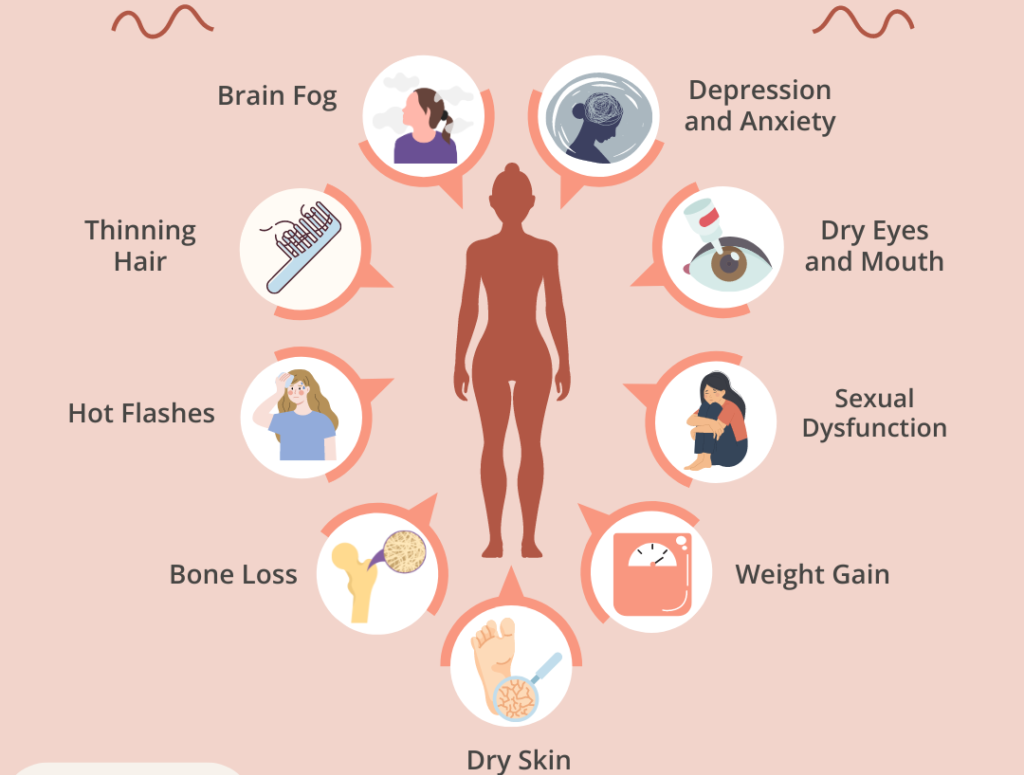
Menopause is a natural stage of aging during which estrogen production ceases. Although declining hormone levels accelerate cellular aging, increased life expectancy depends on a healthy lifestyle: diet, physical activity, quitting smoking, and managing cardiovascular risks.
Obesity and menopause
Experts agree: lifestyle modifications, such as normalizing sleep patterns and physical activity, play a crucial role in improving women’s well-being during menopause. Choosing the right diet is particularly important during this period, as obesity places a significant metabolic burden on the body.
Estrogens, a woman’s natural protectors, also guard against excess weight by suppressing appetite and increasing energy expenditure. Menopause, however, is characterized precisely by a deficiency of female sex steroids and a relative increase in male hormones. This “hormonal storm” is associated with metabolic disturbances and a shift of fat from subcutaneous adipose tissue to visceral fat. This process is extremely dangerous — it is closely linked to the development of carbohydrate metabolism disorders, insulin resistance, dyslipidemia, hypertension, and cardiovascular disease (CVD).
Overweight patients are at high risk for ischemic heart disease, type 2 diabetes (T2D), neurological disorders, and cancer. Thus, obesity is a risk factor (RF) for benign breast diseases; however, obesity of the second degree (or higher) during the menopausal transition becomes a significant risk factor for the development of cancer, including endometrial cancer.
Obesity affects menopausal symptoms: the heavier the patient, the more severe her vasomotor symptoms are, the more intense her hot flashes are, and the more debilitating her insomnia and uncontrollable irritability become.

Mood changes
Some women notice changes in their mood after the onset of menopause. These are caused by a drop in estrogen levels, which is directly linked to serotonin production — the “happiness hormone.” This leads to sudden bouts of irritability, tearfulness, and anxiety. The situation is exacerbated by night sweats, insomnia, and chronic fatigue. If you feel anxious (nervous or restless) or depressed (deeply sad), be sure to see a doctor. They can prescribe a course of antidepressants and supportive medications if necessary.
Cardiovascular diseases
During menopause, due to a drop in estrogen levels and a 10–16% increase in “bad” cholesterol, the risk of heart attacks, strokes, and atherosclerosis rises sharply. Early menopause (before age 45) is particularly dangerous, doubling these risks, as are frequent hot flashes and depression. How can you reduce these risks?
- Regular screening: monitor your blood pressure, blood glucose levels, and lipid profile (cholesterol, triglycerides).
- Avoid smoking and alcohol: these double the already increasing risk of heart disease during this period.
- Physical activity: moderate cardiovascular exercise (such as brisk walking, swimming, or group workouts at the gym) helps control weight and maintain vascular elasticity.
- Medication: if necessary, discuss with your doctor the need for cholesterol-lowering medications or menopausal hormone therapy. It’s important to note that personalized treatment requires ruling out any contraindications!
Sleep problems
Hormonal imbalances often trigger night sweats, sweating, and anxiety. To restore sleep, keep your bedroom cool (18-20°C), avoid caffeine after lunch, and discuss potential menopausal hormone therapy (MHT) with your doctor.
American studies (in particular, a large-scale study by the University of California) show a direct link between reproductive age and longevity. Women who experience menopause later (after age 50-55) are more likely to live to age 90 and beyond, as their bodies remain protected from age-related diseases for longer.
The best evidence-based longevity habits for women

While genetics play a big role in our lives, daily habits have a much greater impact on long-term health and lifespan. Think of this checklist as a simple guide to routines that consistently show the strongest evidence for supporting healthy aging by building sustainable habits that help you stay stronger, healthier, and more resilient over time.
|
Longevity habit |
Action checklist |
|
Strength training |
☐ Lift weights or perform resistance exercises at least 2–3 times per week to preserve muscle and bone health. |
|
Protein intake |
☐ Include 20–30 g of high-quality protein with each meal to support muscle maintenance and healthy aging. |
|
Sleep quality |
☐ Aim for 7–9 hours of sleep nightly and maintain a consistent bedtime and wake-up schedule. |
|
Stress reduction |
☐ Practice a daily stress-management habit, such as meditation, deep breathing, walking outdoors, or journaling for 10–20 minutes. |
|
Cardiovascular fitness |
☐ Get at least 150 minutes of moderate exercise or 75 minutes of vigorous activity each week, plus regular walking. |
|
Hormonal health monitoring |
☐ Track menstrual changes, menopause symptoms, or hormone-related concerns and discuss them with your healthcare provider when needed. |
|
Social connection |
☐ Make time each week for meaningful conversations, family, friends, or community activities to support emotional and cognitive health. |
|
Preventive healthcare |
☐ Stay up to date with recommended screenings, vaccinations, routine blood work, and annual health check-ups. |
Female biohacking requires a different approach due to hormonal cycles and genetic differences. Unlike the male body, which functions according to stable circadian rhythms, the female body changes every month. Ignoring these fluctuations when trying to optimize health can lead to hormonal imbalances and exhaustion.
Longevity isn’t built through a single supplement or breakthrough therapy — it’s the result of consistent daily choices. Every workout completed, every nutritious meal, every good night’s sleep, and every preventive check-up is an investment in your future health. Start with one or two habits, build consistency, and let those small actions compound over the years.
for subscribing!